Showing posts with label Wonder of Engineering. Show all posts

Thursday, February 5, 2026

Great Ancient & Grand Modern Engineering - China has Both! More About Science, Engineering & Technology in China!


Chinese people have built tens of thousands bridges over past thousands of years. The bridges have become an important symbol of Chinese ancient civilization, and demonstrate the intelligence and talent of ancient Chinese people. The oldest bridge still in existence and standing strong in china is the Anji Bridge constructed during the years between 595 and 605.

Ancient Chinese bridges are universally acknowledged and have enjoyed high prestige in the bridge history of both the East and the West. Throughout history, the Chinese nation has erected thousands of ingeniously designed and magnificent bridges. Crossing over mountains, spanning rivers, they have facilitated transportation, beautified landscapes and have become one of the marks of ancient Chinese civilization.

In modern times in particular during the infrastructure boom of the past two decades, bridge-building has proceeded at a rapid pace on a vast scale. Prior to the completion of the Wuhan Yangtze River Bridge in 1957, there were no bridges across the Yangtze River, China's longest, from Yibin to Shanghai, and all overland roads and railways crossing this 2,884 km (1,792 mi.) stretch of the river had to be ferried. There were only seven such bridges in 1992, but that number reached 73 by the end of 2012, including eight new openings in that year alone. In fact out of the top 35 longest bridges in the world China have built 17 of them.

In last decade, China has constructed the most tall buildings, bridges and railways in the world, and educated the greatest number of engineering students, all of which requires advancement in Science, Engineering & Technology (SET).

Here we list 8 Great Ancient Bridges and 9 Grand Modern Bridges in China.


China's Great Ancient Bridges

1. Zhaozhou Bridge

ab1

Known as "China's first bridge", the Zhaozhou Bridge is located in Zhao county, Hebei province. It was constructed by stonemason Li Chun of Sui Dynasty 1,400 years ago. It is the oldest bridge in the world. [Photo/Xinhua]


2. Shuanglong Bridge

ab2

Located in Jianshui, Yunnan province, the Shuanglong Bridge with 17 apertures was constructed in Qing Dynasty.[Photo/Xinhua]


3. Rainbow Bridge

ab3

Located in Wuyuan, Jiangxi province, the Rainbow Bridge was constructed in Song dynasty more than 800 years ago. The 140 meter-long bridge has five apertures and four piers. [Photo/Xinhua]


4. Qiandao Bridge

ab4

Located in Shaoxiang, Zhejiang province, the 382 meter long Qiandao Bridge was constructed in Tang dynasty and repaired in Qing Dynasty (1862). [Photo/Xinhua]


5. Bishui Bridge

ab5

Located in Qufu, Shandong province, the Bishui Bridge was constructed in Ming Dynasty. [Photo/Xinhua]


6. Chengyang Bridge

ab6

Located in Sanjiang, Guangxi province, the Chengyang Bridge was constructed in 1912. It was a treasure of China's wood building. [Photo/Xinhua]


7. Anping Bridge

ab7

Located in Jinjiang, Fujian province, the Anping Bridge is 2,070 meters long. [Photo/Xinhua]


8. Guangji Bridge

ab8

Located in Chaoan, Guandong province, the Guangji Bridge was constructed in Southern Song Dynasty (1170). The 515 meter long bridge has 24 piers. [Photo/Xinhua]


China's Grand Modern Bridges

1. Hangzhou Bay Bridge

mb1

Hangzhou Bay Bridge is the world's longest cross-sea bridge, 36 km in total. Hangzhou Bay Bridge started constructing on November 14, 2003, passed through on June 26, 2007, and put into use on May 1, 2008.


2. Donghai bridge, China

mb2

It was completed on December 10, 2005. It has a total length of 32.5 kilometers (20.2 mi) and connects mainland Shanghai and the offshore Yangshan deep-water port in China.


3. Jiaozhou Bay Bridge

mb3

The Jiaozhou Bay Bridge (or Qingdao Haiwan Bridge) is a length of 42.5 km, the longest bridge built over water in the world in 2011. It was completed in January 2011 and connects the old city of Qingdao on the south coast of the Shandong Peninsula to the west of the Jiaozhoubucht city of Huangdao and shortens the connection to the airport and Qingdao Liuting . The opening and release to traffic took place on 30 June 2011.


4. Danyang-Kunshan Grand Bridge 

mb4

Danyang–Kunshan Grand Bridge hosts a train line that runs between Shanghai and Nanjing in East China’s Jiangsu province. There’s a 9 km long section that flies over the open water of Yangcheng lake. The Danyang–Kunshan Grand Bridge is the world's longest bridge. It is a 164.8-kilometre (102.4 mi) long viaduct on the Beijing–Shanghai High-Speed Railway.


5. "Overwater" Highway Bridge

mb5

China opens their newest engineering masterpiece on August 9th 2015. Locals have been referring to it as the “Over-Water” highway. It’s the first eco-friendly highway built over water in China and boasts beautiful scenic views spanning a 10.9km distance around the country’s mountainous Hubei Province landscape. A 4.4km section of the highway was built over the river valley and connects to the G42 express highway which links Shanghai to Chengdu.


6. Weinan Weihe Grand Bridge

mb6

The Weinan Weihe Grand Bridge (渭南渭河特大桥) is a part of the Zhengzhou–Xi'an High-Speed Railway which connects Zhengzhou and Xi'an, in China. The bridge is 79,732 metres (261,588 ft) (49.5 Miles) long crossing the Wei River twice, as well as many other rivers, highways and railways.


7. Tianjin Grand Bridge

mb7

Tianjin Grand Bridge is 113.7 km long railway bridge connecting Langfang and Qingzian. It is one of the longest bridges in the world. It was completed in 2010 and operational for public use in 2011. It is also hold record in Guinness world records as second longest bridge in the world.


8. Beijing Grand Bridge

mb8

Beijing Grand Bridge is a 48.153 kilometres (29.921 mi) long railway viaduct on the Beijing–Shanghai High-Speed Railway, located in Beijing. It was completed in 2010 and opened in 2011. It is one of the longest bridges in the world.


9. Hong Kong-Zhuhai-Macao Bridge

mb9.0

mb9.1

mb9.2

mb9.3

One of the on-going China's Mega Bridge Project, the "Hong Kong - Zhuhai - Macao Bridge" has entered the final stage in construction. 

The Bridge consists of a series of bridges, 2 man-made artificial islands and undersea tunnels that will connect Hong Kong, Macau and Zhuhai, three major cities on the Pearl River Delta (PRD) in China.

Thursday, December 11, 2025

The Lalbagh Fort! An engineering beautiful incomplete architecture by Mughal Prince Muhammad Azam Shah, History and Research.

The Lalbagh Fort (Bengali: লালবাগ কেল্লা) , romanized: Lālbāg Kēllā) is a historic fort situated in the old city of Dhaka, Bangladesh. It's name is derived from its neighborhood Lalbagh, which means Red Garden. The term Lalbagh refers to reddish and pinkish hues in the Mughal architecture. The original fort was called Fort Aurangabad. Its construction was started by Prince Muhammad Azam Shah, who was the son of Emperor Aurangzeb and briefly a future Mughal emperor himself. After the prince was recalled by his father, the fort's construction was overseen by Shaista Khan, the Subahdar of Mughal Bengal. The death of Shaista Khan's daughter Pari Bibi (Fairy Lady) resulted in a halt to the construction process, apparently due to Shaista Khan's superstition that the fort brought bad omen. Pari Bibi was buried inside the fort.

Lalbagh Fort was built as the official residence of the governor of the Mughal province of Bengal, Bihar and Orissa. The complex includes the Mughal governor's house, the tomb of Pari Bibi and a mosque. It is covered by lawns, fountains and water channels. Its two south gates were previously grand arches. The original grand complex covered the governor's house and the two archways. The tomb of Pari Bibi was later added. Lalbagh Fort was modelled as a miniature version of great Mughal forts like the Red Fort and Fatehpur Sikri. During the reign of Emperor Aurangzeb, Mughal Bengal became the economic engine of the empire. Emperor Aurangzeb called Bengal the Paradise of Nations. Dhaka grew into an imperial city with one of the richest elites in the Mughal Empire, including members of the imperial family. Mughal artillery guarded the fort. Once located beside the Buriganga River, the river has retreated from the vicinity of the fort. The fort was depicted in European paintings during the 18th and 19th centuries.

Today, Lalbagh Fort is one of the most visited sites in Dhaka. Several pieces of artillery are kept inside the fort. The Ambassadors Fund for Cultural Preservation is funding a restoration project for parts of the fort. Lalbagh Fort is one of the most recognized symbols of Mughal rule in Bengal.

An aerial view of Lalbagh Fort

History

South gate of the fort painted by Johan Zoffany in 1787

The Mughal prince Muhammad Azam Shah, third son of Aurangzeb started the work of the fort in 1678 during his vice-royalty in Bengal. He stayed in Bengal for 15 months. The fort remained incomplete when he was called away by his father Aurangzeb.

Shaista Khan was the new subahdar of Dhaka in that time, and he did not complete the fort. In 1684, the daughter of Shaista Khan named Iran Dukht Pari Bibi died there. After her death, he started to think the fort as unlucky and left the structure incomplete. Among the three major parts of Lalbagh Fort, one is the tomb of Bibi Pari.

After Shaista Khan left Dhaka, it lost its popularity. The main cause was that the capital was moved from Dhaka to Murshidabad. After the end of the royal Mughal period, the fort became abandoned. In 1844, the area acquired its name as Lalbagh, replacing Aurangabad, and the fort became Lalbagh Fort.

Architecture

Tilework inside one of the buildings of Lalbagh Fort

For long the fort was considered to be a combination of three buildings (the mosque, the tomb of Bibi Pari and the Diwan-i-Aam), with two gateways and a portion of the partly damaged fortification wall. Recent excavations carried out by the Department of Archaeology of Bangladesh have revealed the existence of other structures.

The southern fortification wall has a huge bastion in the southwestern corner. On the north of the south fortification wall were the utility buildings, stable, administration block, and its western part accommodated a beautiful roof-garden with arrangements for fountains and a water reservoir. The residential part was located on the east of the west fortification wall, mainly to the southwest of the mosque.

The fortification wall on the south had five bastions at regular intervals two stories in height, and the western wall had two bastions; the biggest one is near the main southern gate. The bastions had a tunnel.

The central area of the fort is occupied by three buildings—the Diwan-i-Aam and the hammam on its east, the mosque on the west and the Tomb of Pari Bibi in between the two—in one line, but not at an equal distance. A water channel with fountains at regular intervals connects the three buildings from east to west and north to south.

Diwan-i-Aam

The Mughal governor's residence (Diwan-i-Aam) and its attached hammam

Diwan-i-Aam is a two-story residence of the Mughal governor of Bengal located on the east side of the complex. A single-story hammam is attached on its west. The hammam portion has an underground room for boiling water. A long partition wall runs along the western facade of the hammam.

The building is situated about 39 metres (128 ft) to the west of the tank, running from north to south. The external measurements of the building are 32.47 by 8.18 m (107 by 27 ft).

There are living quarters on each level of two stories and a main central hallway connecting them. There is a Hammamkhana (bathhouse) in the southern part of the building, which is one of the seventh Hammamkhana still existing in ruins in the heritage of Bangladesh.

Recent excavations (1994–2009) show that there was a special room below the room of Hammamkhana, where archaeologists found the arrangements for heating water, supplying the hot water as well as cool water to the Hammamkhana through the terracotta pipes which were specially manufactured for such purpose. The discovery of black spots in the underground room proved that fire had been used for the purpose of heating the water for the Hammamkhana. There was also a toilet room by the side of Hammamkhana.

All the buildings along with the arrangements of Hammamkhana clearly show that it was very much in use by the Subadar of Bengal and that Subadar was Shaista Khan. From the report of the Governor of English Factory, it was learned that Shaista Khan used to live in this room and some Europeans were kept in custody here.

A water tank

A square-shaped water tank (71.63 m (235 ft) on each side) is placed to the east of the Diwan-i-Aam. There are four corner stairs to descend into the tank.

Hammamkhana of Lalbagh Fort

Tomb of Bibi Pari

The tomb of Bibi Pari, the daughter of Shaista Khan, is in the middle of the complex. There is a central square room. It contains the remains of Pori Bibi, covered by a false octagonal dome and wrapped by a brass plate.The entire inner wall is covered with white marble. Eight rooms surround the central one. There is another small grave in the southeastern corner room.

Lalbagh Fort Mosque

The mosque has three domes and is relatively small for a large site, with a water tank for ablutions in front. The mosque has an oblong plan of 20.34 m × 10.21 m (66 ft 9 in × 33 ft 6 in) externally and 16.36 m × 6.15 m (53 ft 8 in × 20 ft 2 in) internally.

Mosque

Stories

View from the Buriganga River in 1799. Painting by Robert Home

From the time of construction till date, various myths have revolved around the fort. Among all the historical stories and debates, it is widely believed that Lalbagh Fort stands as a monument of the unfulfilled dreams of Prince Muhammad Azam Shah, beloved son of Emperor Aurangzeb. In the mid-17th century, he was serving as the Viceroy of Bengal and began the construction of the impressive Lalbagh Fort complex.

Therefore, the popular stories about the fort begin. Before the construction was finished, Prince Azam was called back to his father to assist in the war against the Marathas. Legend says after the Mughal prince departed, Shaista Khan continued with building the project, but upon the untimely death of his much-loved daughter Iran-Dukht, warmly known as Pari Bibi, the construction was stopped. Bibi was engaged to Prince Azam at the time of her death.

There are also legends and debates about the identity of Pari Bibi. Few researchers claim she was a nine-year-old Ahom princess. Mir Jumals Ahom's expedition brought a war adjoining the Garo hills. He took the daughter of Ahom Raja to compel him to execute the previous peace treaty. Later, the emperor made her convert to Islam and married her off to Prince Azam. However, overshadowing all the debates, people now believe that she was the loving daughter of Nawab Shaista Khan.

Research

Lalbagh Fort Ground

Archeologists discovered the continuity of the main fort walls eastward below Shaishta Khan Road. They opined that the present area of Qilla represents half the portion as planned by Prince Azam Khan. The gate at the southeast of the fort (adjacent to Lalbagh Shahi Masjid) as per requirement fits properly as the Central Gate in the middle of Fort. The other half to the east—likely planned for administrative purposes (Girde Qilla area)—were incomplete or extinct long ago.

There are some tunnels in the fort which are now sealed. It is said that two of the tunnels lead to now ruined Zinzira Fort which was on the other side of the Buriganga River. Another passage was made as a maze. It is claimed that many defeated sepoys (soldiers) of the Sepoy Revolution of 1857 tried to run away through the passage and lost their lives. The British soldiers who chased them to arrest also did not return. To investigate the claim, British researchers sent an elephant and dogs to the tunnel but they did not return either. After that, the tunnels were sealed.

Aerial view of Lalbagh For

Thursday, December 4, 2025

History of the Pyramids of Giza, which is the oldest great engineering creation of the world!

The Pyramids of Giza have watched the Nile valley for more than 4,500 years — royal tombs, engineering triumphs, and the world’s most enduring monuments. Now a UNESCO World Heritage Site and one of the Seven Wonders of the World. Before you plan a visit, learn more about the history of the Pyramids of Giza.

Pyramids of Giza entrances

Pyramids of Giza timeline: key dates at a glance

c. 2670 BC: Step Pyramid of Djoser at Saqqara: the dawn of stone monumental building.

c. 2630 BC: Snefru’s Red Pyramid (Dashur): the first true smooth-sided pyramid.

c. 2560 BC: Great Pyramid of Khufu completed (the high-point of Giza’s building era).

c. 2530 BC: Pyramid of Khafre finished; the Great Sphinx carved nearby.

c. 2510 BC: Pyramid of Menkaure completed; royal pyramid building declines in scale.

820 AD: Caliph al-Ma’mun tunnels into the Great Pyramid in search of treasure.

1196 AD: Attempted demolition by Sultan Al-Aziz; site survives with minor damage.

18th–19th centuries: European explorers map and record the site systematically.

1979: Giza becomes part of a UNESCO World Heritage listing; modern conservation begins.

21st century: Non-invasive scanning (muon imaging, radar) reveals hidden voids and new research directions.

History of the Pyramids of Giza explained

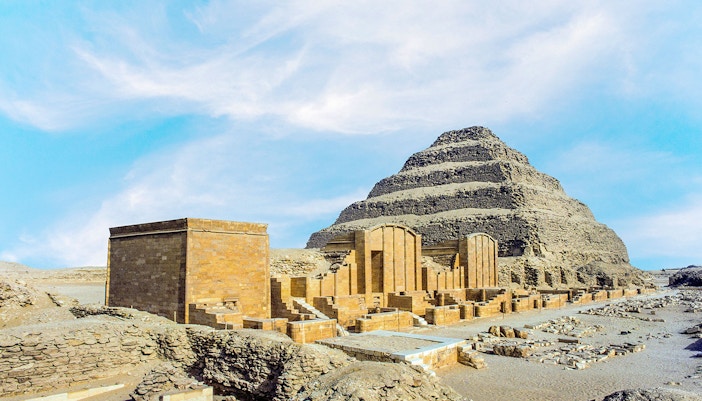
Pyramid of Djoser at Saqqara necropolis, Egypt, with surrounding ancient structures.

Origins of pyramid building

Egypt’s pyramid tradition began with mastaba tombs, later evolving into step pyramids like Djoser’s at Saqqara. By the 4th Dynasty, builders perfected smooth-sided pyramids, paving the way for Giza. These monuments reflected not just architectural skill but also deep religious beliefs in kingship and the afterlife.

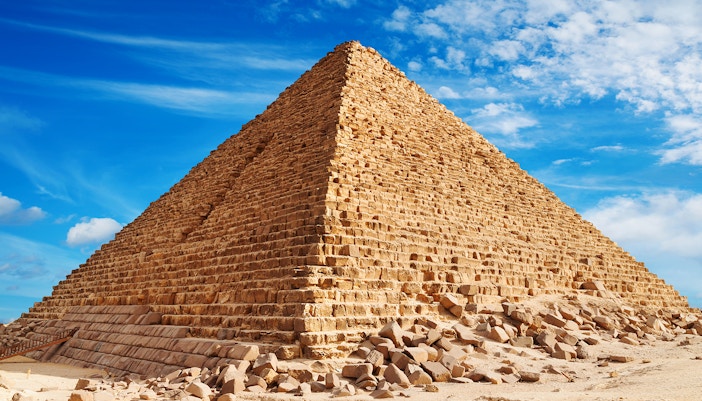
Pyramid of Khufu in Giza under a clear blue sky.

The Great Pyramid of Khufu

Completed around 2560 BC, Khufu’s pyramid is the largest ever built. Standing originally at 146.6 meters, it used over 2 million limestone blocks. Inside lie corridors, chambers, and hidden spaces still being studied today. This masterpiece defined Egypt’s golden age of pyramid construction.

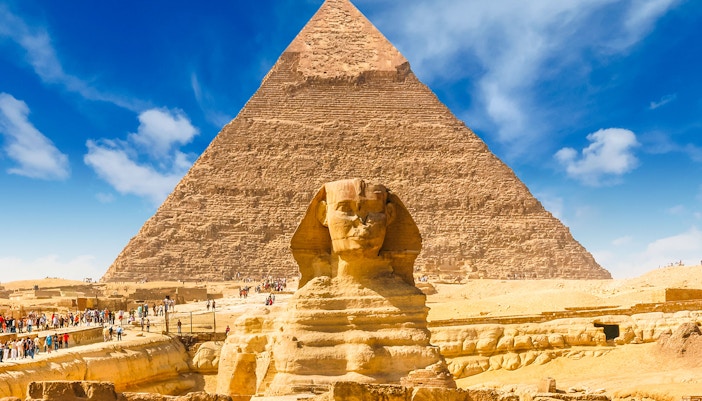
Sphinx and Pyramid of Giza in Cairo, Egypt.

The Pyramid of Khafre and the Sphinx

Khafre’s pyramid looks taller than Khufu’s thanks to its elevated base and surviving limestone casing. It is also linked to the Great Sphinx — the massive lion-bodied, human-headed guardian carved from bedrock. Together, they form the classic Giza silhouette.

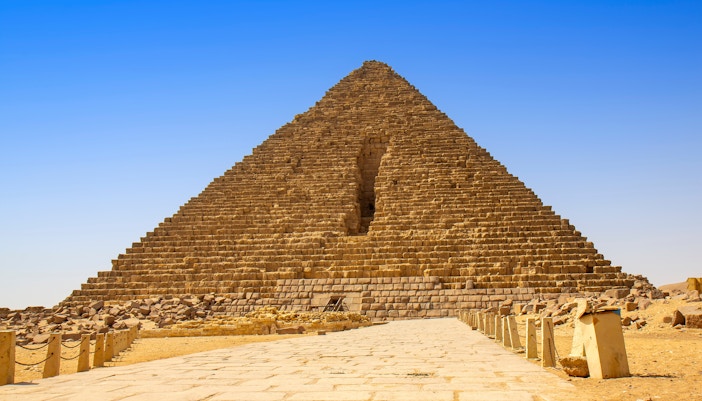
Pyramid of Menkaure exterior with stone pathway, Giza, Egypt.

Menkaure’s pyramid and smaller complexes

The last of the main pyramids, Menkaure’s structure is smaller but finely built. Excavations revealed associated temples, causeways, and queens’ pyramids, showing that Giza was more than three tombs — it was an entire ceremonial landscape.

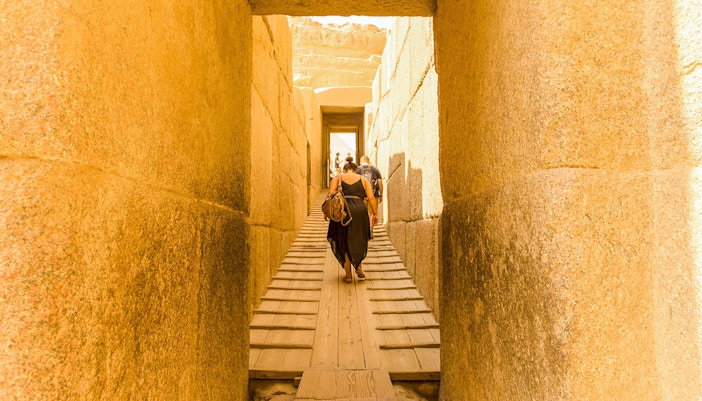
Visitors walking through ancient stone passageway at Giza Pyramids, Cairo.

Life around the pyramids

Archaeology shows workers were not slaves but skilled laborers. Excavations uncovered housing, bakeries, and medical care, proving pyramid building was a national project, not forced toil. This insight reshapes how we understand life in ancient Egypt.

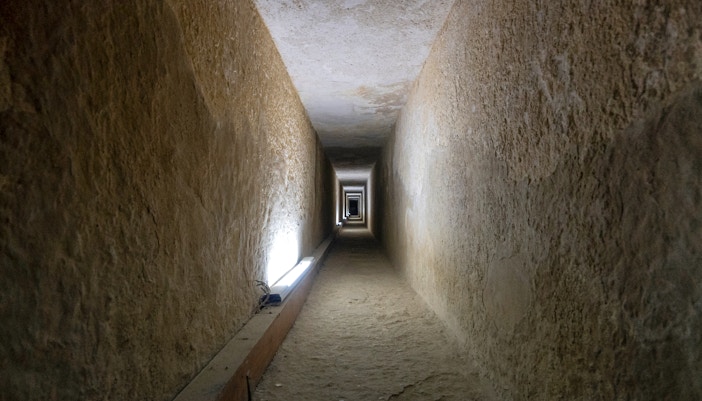
Tunnel entrance to ancient Egyptian pyramid with hieroglyphics on walls.

Rediscoveries and modern research

From medieval explorers tunneling inside to today’s muon scans and radar imaging, each era added new knowledge. Modern technology continues to reveal hidden chambers and refine our understanding of how the pyramids were built.

Construction of the Pyramids of Giza

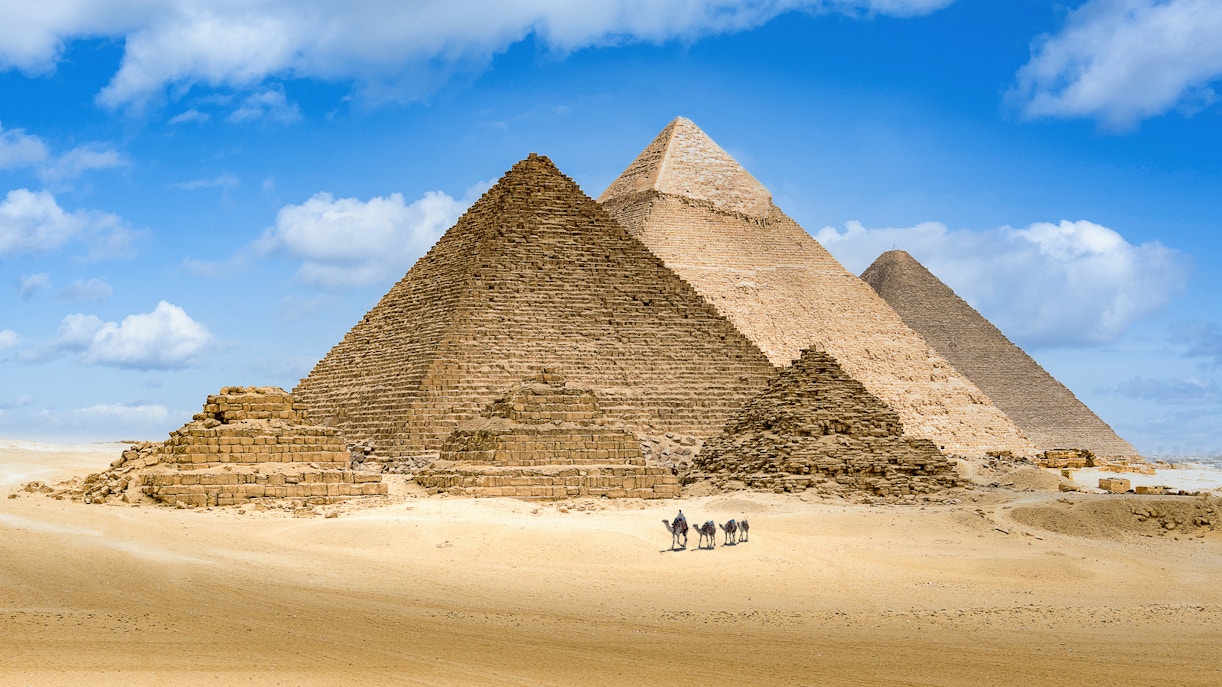
Pyramids of Giza with camels in the foreground under a blue sky.

The Pyramids of Giza were feats of planning, logistics, and human effort. Archaeologists now believe most limestone was quarried on-site, with granite hauled from Aswan. Workers moved blocks on sledges over wet sand or ramps, and the nearby Nile may have helped transport heavy stone. Far from being slave labor, evidence shows a well-fed, organized workforce of thousands. Their knowledge of astronomy, geometry, and engineering ensured the pyramids aligned with cardinal points and stood the test of time.

Plan your visit to the Pyramids of Giza
Additional historical insights
  • Pharaoh Thutmose IV restored the Sphinx, leaving a stone tablet between its paws as proof.
  • Khufu’s solar boats, buried beside his pyramid, reflect ancient beliefs in a pharaoh’s eternal journey.
  • Medieval rulers tried dismantling the pyramids but quickly abandoned the task.
  • Modern scans using cosmic rays revealed hidden voids inside the Great Pyramid.
  • Discoveries and age-old mysteries continue to keep Giza in the global spotlight.

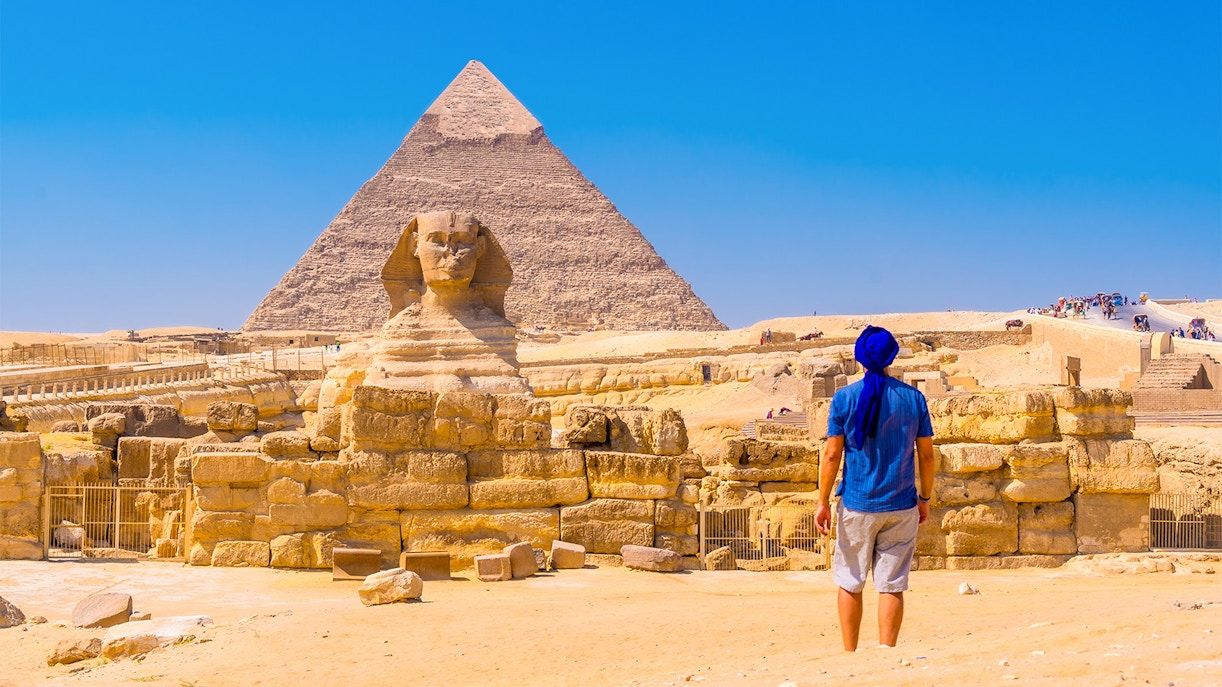
The Pyramids of Giza today

Person viewing the Sphinx and Pyramid of Giza in Egypt.

Recognized as a UNESCO World Heritage Site since 1979, the pyramids remain Egypt’s most visited attraction. They are the last surviving Wonder of the Ancient World, welcoming millions each year. Visitors describe the experience as awe-inspiring, though often busy and hot — reviews suggest arriving early or booking a guided tour for context and convenience. Beyond daytime visits, sound-and-light shows bring history to life under the night sky, making the pyramids as enchanting today as they were mysterious in antiquity.

Last update post

Great Ancient & Grand Modern Engineering - China has Both! More About Science, Engineering & Technology in China!

Chinese people have built tens of thousands bridges over past thousands of years. The bridges have become an important symbol of Chinese anc...