
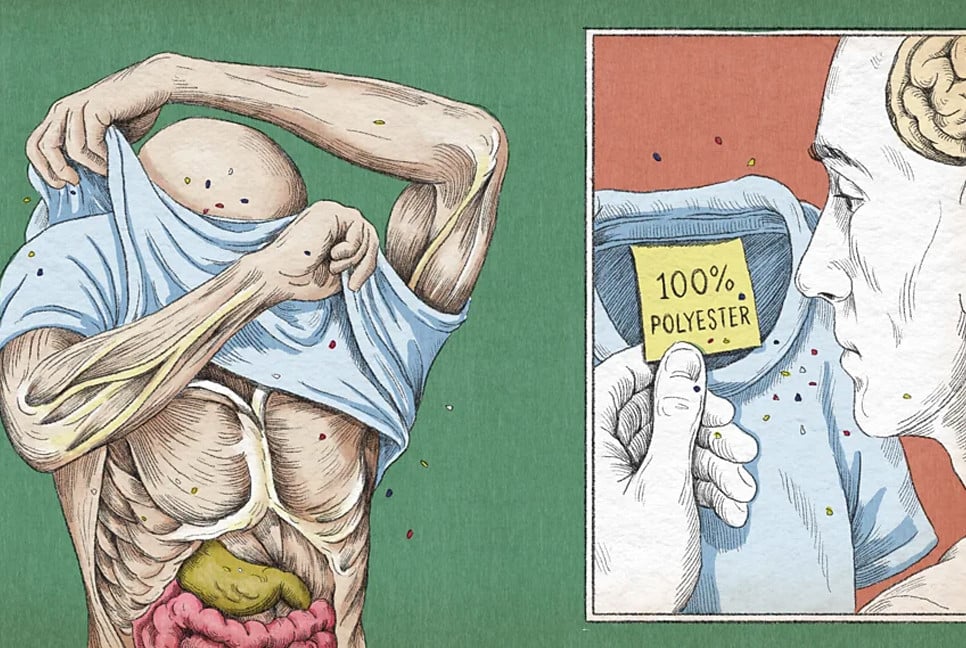
Clouds of invisibly small microplastics concentrate in the air of our homes, and we could be breathing in hundreds of thousands to millions of them each year. A few small changes can help us reduce our exposure.
If you look at the labels of the clothes you threw on today, chances are at least some of them use synthetic fabrics. They're cheap, colourful and come in an endless array of textures, weights and degrees of stretch. But these convenient garments are also among of the main culprits infusing the air in our homes with invisible pollution: microplastics.
When you wash and dry your polyblend jumper, for instance, shake it out, pull it on over your head, or just go about your day wearing it, countless minuscule fibres are released into the air. Take a breath, and a cloud of these tiny particles can flow into your airways.
We're just beginning to unravel the breadth of airborne microplastic exposure and its effect on our health, but what's already known is raising concern.
Scientists believe the majority of our exposure to microplastics happens when we're indoors. The good news is there are things we can do about it in our homes, from reconsidering the clothes and furnishings we buy, to changing the way we wash our clothes and clean our houses.
"Microplastics are everywhere, and there's no way you can avoid them," says Dana Barr, an exposure science professor at Emory University in Atlanta, the US. "But there are ways that you can significantly reduce your exposure over time, and it's mostly from behavioural change."
The air in our homes
Invisibly small fragments of plastic are all around us. They're expelled from virtually every product made of plastic (over 460 million tonnes of new plastic is produced every year). They make their way into our bodies via the food and water we consume, the products we use on our skin and the tiny particles we inhale when we breathe. (Read more on the microplastics in our food and how to eat less of them.)
Food and water was once thought to be the main way microplastics entered the body, but some scientists now believe that inhalation may in fact be the predominant route.
For instance, take a meal of filter-feeding shellfish like mussels, which can have high concentrations of microplastics. You're likely to inhale more plastics during the meal preparation than you eat from the food itself, according to one study. In countries where shellfish makes up a large part of the diet, you might expect to eat 4,620 particles per year. But you could be inhaling around three to 15 times more particles a year during mealtimes.
In developed countries, people spend about 90% of life indoors, which is one reason that the potential for microplastic inhalation is significantly higher compared to outdoors. A 2021 study examining airborne microplastics indoors and outdoors in China found that the concentration was eight times higher in indoor air. Even where natural fibres predominated over synthetics, and laundry – a considerable source of microplastics – was typically hung outside, microplastics were still at higher concentrations indoors.
"The fact that we're spending so much time indoors, and we're breathing the air indoors, means that we probably are vastly underestimating exposure," says Barr, who also is a director at the Hercules Exposome Research Center.
Just how many microplastics are in your home depends on where you live, what kinds of synthetic materials you have on your soft furnishings and in your wardrobe, what your flooring is made from, and how you clean and ventilate your space. Another study found that an individual in the US could be inhaling up to 22 million micro- and nanoplastics per year.
Wherever you live, microplastics are very likely to be in every room of your home. But where exactly do these fragments gather, and where do they come from?
Dust laced with plastic
When tiny fragments of plastic settle from the air, they often end up in household dust.
Even though dust settles, it can easily get kicked up into the air when disturbed by any sort of friction. Jeroen Sonke, a biogeochemist at the French National Center for Scientific Research who co-authored a recent study on indoor airborne microplastics, investigating the presence of small microplastics in the range of one to 10 micrometres, which penetrate deeper into the lungs than larger fragments.
Sonke and his colleagues looked inside three of their own apartments in Toulouse, France, to take samples, and collected further samples from inside two cars (where people in developed countries typically spend another 5% of their time). Sonke was surprised to find an average of more than 500 fragments in one cubic metre of air indoors, and more than 2,200 fragments inside the cabin of a car. He noted that these samples were mainly from stagnant air, but if people were present stirring up dust, the air would likely have many more microplastics.
For a baby crawling on the ground, their faces can be inches away from microplastic-filled dust. Sonke and his colleagues calculated the amount of microplastics an infant may inhale on an average day ranged between 19,000 and 75,000 particles in the 1-10 micrometre range. For adults, it was 28,000 to 108,000 particles a day.
These numbers come with a caveat: it remains challenging for scientists to unequivocally measure the amount of microplastics in the air. "There's no gold standard approach for measuring microplastics, and there may never be," says Douglas Walker, an associate professor of environmental health at Emory College, noting this makes it difficult to compare findings between studies.
And it's especially hard to measure smaller microplastics, which can find their way deeper into the lungs. Standard microscopes tend to have a lower limit of around 20 micrometres, though the technology is improving, Sonke notes. The method his team used (Raman microscopy) allowed them to get down to the 1 micrometre microplastic range for the first time.
Contamination also complicates the picture. The clothes scientists wear, which release clouds of microplastics, make it hard to get reliable results. Even the coating on latex gloves that scientists often wear during experimental work can accidentally influence samples, one study found.
Clothes, soft furnishings and carpets
Microplastics come in all different shapes and sizes, including spheres, flakes, foams and fragments. The predominant type of airborne microplastics come from textiles, such as the clothes we wear, the upholstered chairs and sofas we sit on, and the carpets we walk on.
"Indoors we do surround ourselves with lots of plastic materials, and things like upholstery, your furniture, your curtains, your bedding, your clothing, are all things that undergo daily wear and tear," says Stephanie Wright, a microplastics researcher and associate professor in the Faculty of Medicine at Imperial College London. "So literally as we use them, as we sit on them, as we move on them, as we wash them, as we hoover them – all these mechanical ways in which we wear them down generate microplastic as well."
These microplastics take the form of tiny fibres, and they're generated in the home more or less wherever plastic fibres are heated or come under friction.
Domestic laundry dryers do both to fabrics, releasing microplastics into the air of the room around them as they work. Washing machines are also a considerable source of microplastics, though here many of them drain out of the home to contaminate waterways.
If you own your washing machine, you can purchase a filter for your washing machine that can reduce up to 90% of microfibres from wastewater. Annelise Adrian, a senior programme officer with the plastics and material science team at World Wildlife Fund, also recommends doing larger loads of laundry to reduce friction between clothes during the process.
Wright adds that alongside technological innovations, we can change our habits too. "You can try and be as efficient as possible and only wash clothes when you need to," she says. When weather and access permit, you could consider drying your clothes outside, she adds.
Switching to clothes made exclusively from natural materials, such as cotton, wool or linen, can also reduce your exposure to fibrous microplastics. Unlike plastic, natural fibres break down in the body. However, they tend to be pricier than synthetic clothing and require more land and other resources to make. Cotton fibres, for example, require substantially more water to produce than synthetic fibres.
If you are going to wear synthetic clothes, buying used, second-hand garments may also limit microplastic exposure, although scientists are somewhat divided on this. "Some are saying that used clothes have already shed their loose fibres and are less prone to shedding," says Adrian. "However, others argue that used clothes can accumulate more microplastics from all the washes they've undergone, and fibres can break and weaken over time."
Instead, buying used natural-fibre clothes, such as organic cotton or organic wool products, would be "the gold standard", says Adrian.
After minimising the synthetic textiles around you, a good next step is to try to remove the plastic dust in your home, says Wright.
Vacuuming
A thorough vacuum can suck up microplastics that have settled on your floors and furniture, but it can simultaneously send particles back into the air as you clean. You'll also get a face full when you empty the bag or canister into the bin, says Barr.
"What [vacuuming] does do is it resuspends particles that it's not picking up," says Barr. She suggests wearing an N95 mask while vacuuming or dusting may help protect you. Wright also recommends vacuuming and emptying the dust from the machine in a well-ventilated space.
Vacuums with high-efficiency particulate air (Hepa) filters and a sealed system can help limit your exposure to airborne microplastics while you clean. Their filters are designed to trap smaller particles and prevent them from being released. But they're not perfect devices either; even the best Hepa-filtered vacuum will still resuspend some microplastic particles, says Barr.
Adrian suggests coupling vacuuming with other ventilation methods to lower airborne exposure. "If you are cleaning, have a source of ventilation, like an air filter, or open your window."
However, resuspension of microplastics during vacuuming is thought to be a temporary problem. A study across 29 countries found that regular vacuuming lowered microplastic levels. Vacuum cleaners that are properly maintained, with their filters and dust collectors regularly emptied and cleaned, also help to reduce air pollution indoors more generally.
"You're getting rid of [the microplastic], essentially, before it has chance to become airborne again," says Wright.
Mopping and wiping hard surfaces with a wet cloth before you vacuum can help tamp down microplastics so fewer become airborne, says Barr. However, be wary of the products you use to wipe down surfaces; some cleaning products, such as wipes and sponges, can also generate microplastics.
Air filters and air conditioning
It may be impossible to remove microplastics from the air completely, but some simple home devices can help limit your exposure. Hepa air filters are designed to theoretically remove at least 99.97% of airborne particles around 0.3 micrometres (typically the trickiest size to filter). One study that analysed micro- and nanoplastics alongside other air pollution found that a true Hepa filter could remove over 99% of nanoparticles from the atmosphere.
Not all Hepa air filters are created equal, however. Even if they've met the Hepa standards, their construction and functionality could impact how well they capture plastic particles in the average home. Considering that, if you're going to invest in one, Barr suggests models that have numerous filtering stages.
"They have some coarse areas and then fine filtration areas. The more of those filters you have, the more they're stacked, the better off you're going to be, because you're going to be able to filter out multiple sizes of particles," Barr says. Air filtration systems like this tend to have a larger capacity, allowing for a greater surface area to absorb more particles in a range of sizes.
Air conditioning, meanwhile, may not be so helpful for reducing microplastics. Microplastics accumulate on air conditioning units, one study found, and could distribute microplastics around the room when operating. Strong air conditioning can even increase the emission of microplastics from textiles. A study in Colombia found higher concentrations of microplastics in rooms with air conditioning than those without.
Health impacts
Microplastics are present in our bodies in abundance. Exactly what these microplastics do once they are inside us is less clear. Some microplastic particles may settle in the mucus lining the airways and be cleared out without entering the body's tissues. Some, however, may travel deeper. One study of different human tissues found the highest concentration of microplastics was in the lungs.
Smaller microplastics of less than 20 micrometres can cause inflammation, while particles smaller than five micrometres can make their way inside cells and accumulate in different organs. These smaller particles are not filtered by the nose but rather travel down to the lungs where they become lodged. In mice, one study found that inhaled microplastics travelled to the thymus, spleen, testes, liver, kidneys and brain within three days, and caused inflammation in multiple organs.
"Fibres have the worst impact on health when inhaled," says Adrian. "The fibre shape enhances retention of toxins."
Fibre microplastics can also go deep into your body, past your lungs, into your bloodstream and lymphatic system, where they can interfere with cellular biology. Compared with other shapes, longer fibres may also persist longer in the body, notes Adrian.
"The thinner the fibre, and the smaller, on average, the fibre is, then the more likely it is to penetrate deeper into our airways, and deeper into the lung," says Wright.
Based on what we know from other types of tiny fibres, those dimensions are problematic, she says, based on what we know about mineral fibres such as asbestos or carbon nanotubes. "We know that those fibres – small enough to javelin down into the air sacs at the end of our airways – are problematic."
For microplastic fibres, the picture is still unclear, says Wright. "Would they cause the same effect? Or the fact that they're flexible, whereas mineral fibres are very rigid, does that make [microplastics] less toxic, less harmful?"
Beyond their potential to interfere with tissues, there's also the concern that microplastics often come with company. They are home to a broad range of bacteria, and may carry other contaminants too. It's been suggested that microplastics might act to amplify the toxicity of other pollutants in the environment. This field of research, however, is still in its early days, and the full effects of microplastics on the body are still not yet understood.
To solve the microplastic pollution crisis will take a lot more than changes within the home – there are plenty of broader sustainability concerns too. If moving to replace synthetic fibres in your home with natural fibres, for instance, there's also the greater water and land use from organic cotton use to think about. Or if choosing to ventilate your home more to usher away microplastics, that pollution is only being pushed outdoors. Short of systemic change and a global reduction from the 460 million tonnes of plastic made each year, there's only so much individuals can do.
"It's tricky, isn't it?" Wright concedes. "Because I feel like in these scenarios, it's pick your battles."
Courtesy: BBC
Bd-Pratidin English/ AM



.png)


